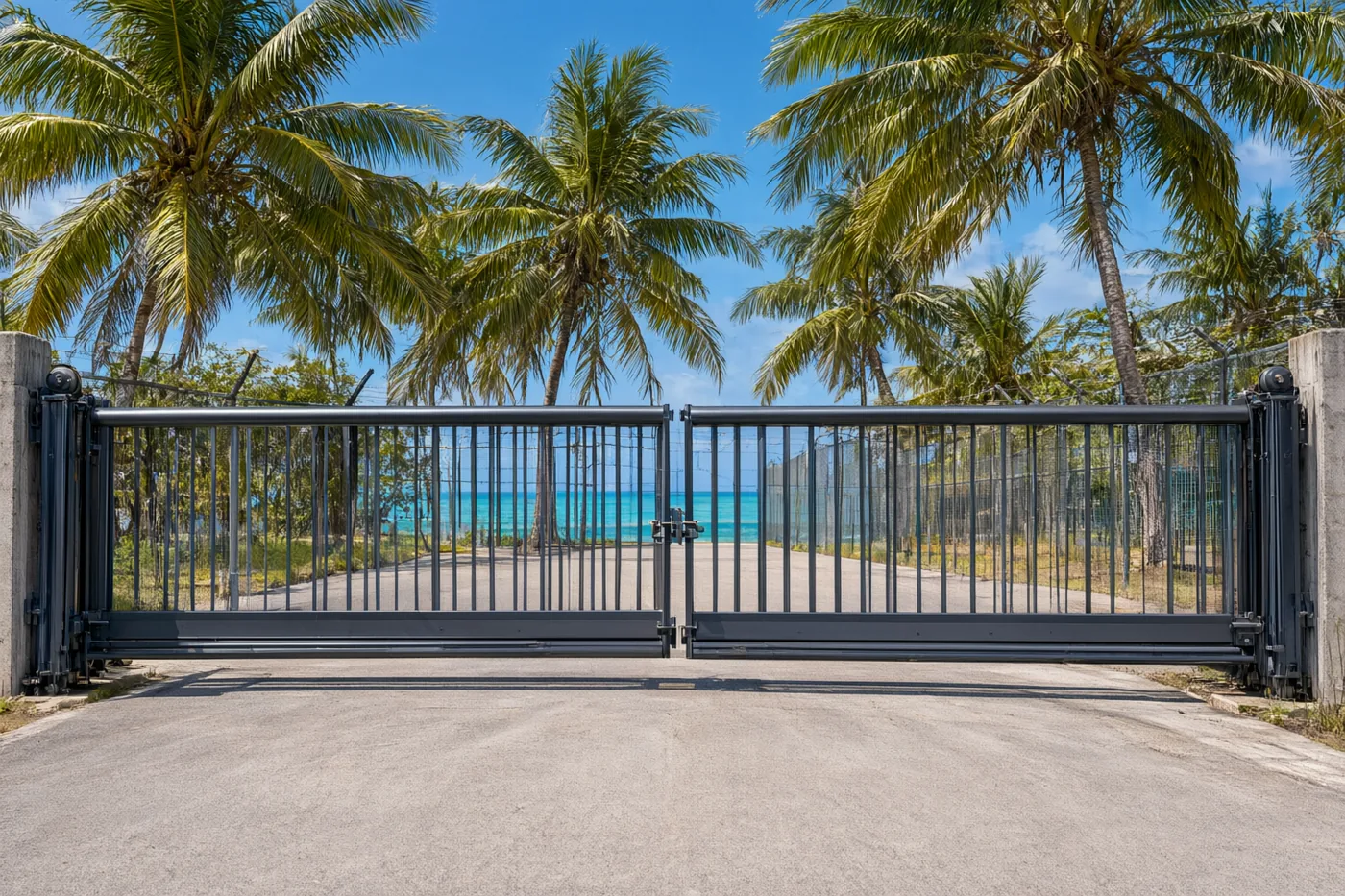
Some openings are just too wide for one leaf. A bi-parting cantilever gate fixes that by splitting the gap in two, with each leaf rolling back from the center to its own side. We build this double cantilever gate layout for clear openings up to 36 m (118 ft). That's twice the span of our single leaf. Picture a perimeter service road, or a logistics yard where trucks queue from both directions, or a plant gate where oversize loads need every meter they can get. If that sounds like your site, keep reading. Below you'll find when two leaves make sense, which opening mode suits you, how the ground work goes and what we need to quote it.
Why one leaf stops working past 18 m
A single CAIMEN cantilever leaf tops out at 18 m (59 ft) of clear span. Go wider and the numbers get ugly fast.
Here's why. A cantilever leaf is always longer than the hole it closes, because it needs a counterbalance tail behind the carriage to keep the nose from dropping. Our installation manual has an opening-to-gate-length table, and every row in it lands on the same ratio of 1.5. So a 6,000 mm opening gets a 9,000 mm gate. A 7,500 mm opening gets 11,250 mm. Other makers work the same way; Hoover Fence's chain link cantilever installation manual sets the counterbalance at half the opening, with a 4 ft minimum.
Scale that to 30 m and you're looking at a leaf around 45 m long. You'd also need 45 m of clear fence line on one side just to park it. Hardly anyone has that. And it couldn't be shipped anyway, since our longest delivered leaf is 28 m.
Speed is the other problem. Our 500 W variable-frequency drive moves a leaf at 18 to 22 m/min, so at 20 m/min a leaf clearing 22 m needs more than a minute. Split the job between two leaves of 11 m each, running together, and it's done in about half the time. You'll notice. Especially with an ambulance idling at the line.
What a bi-parting layout changes
Side space is the big win. Each leaf parks on its own side, and each side needs a straight run of about three quarters of the total opening. For 36 m, that's roughly 27 m left and 27 m right, not one run nobody can find.
Each leaf also stays within limits we can actually build. An 18 m clear leaf works out to about 27 m overall if the same 1.5 ratio holds, which is just under the 28 m delivered maximum; we confirm the final length on your drawings. Travel per leaf drops by half at the same drive speed.
The catch? You buy two of everything. Two drives, two foundations, two power feeds, plus a center meeting point that has to line up properly. That's the honest price of the layout, and it's worth it only when one leaf truly can't do the job.
| Point | Single leaf | Bi-parting (two leaves) |
|---|---|---|
| Maximum clear span | 18 m (59 ft) | 36 m (118 ft) |
| Storage space | One side, about 1.5x the opening | Both sides, about 0.75x the opening each |
| Travel to fully open | Full opening width | Half the width per leaf |
| Drives and foundations | One set | One set per side |
| Best fit | Openings up to 18 m with room on one side | Openings over 18 m, or tight room on each side |
Double opening vs opposite opening
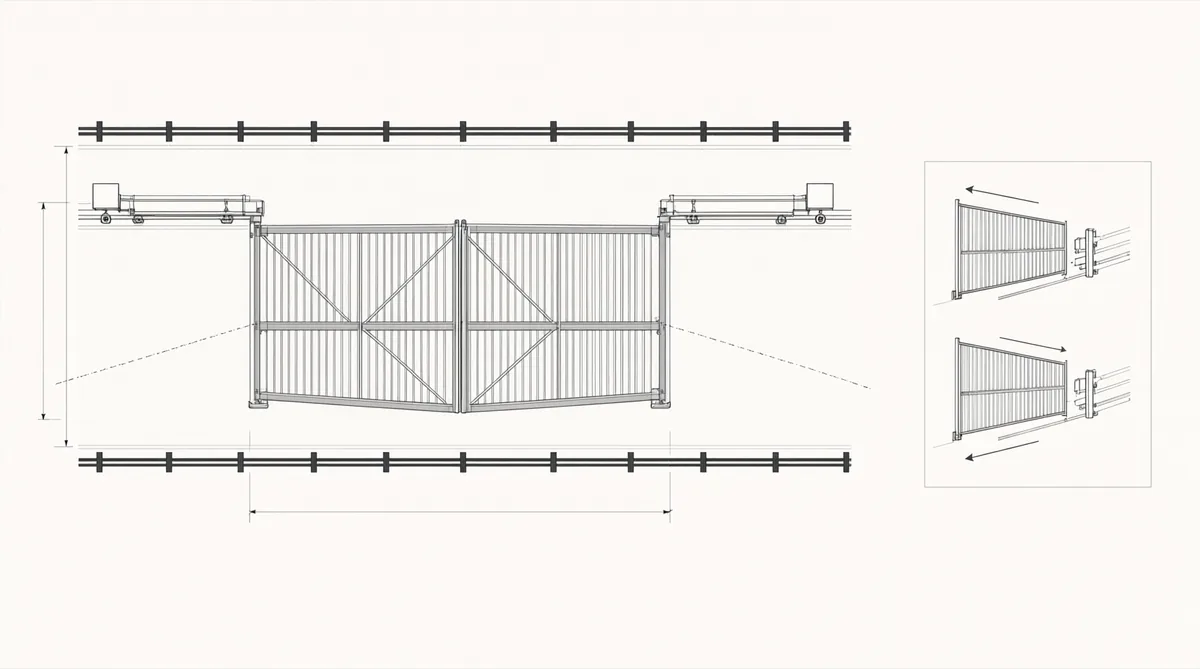
Our installation manual lists four opening modes: left single, right single, double opening and opposite opening. Only the last two are bi-parting. They look and behave differently where the leaves meet.
Double opening
Both leaves share one centerline. They close nose to nose, synchronized, so anyone looking from the road sees a single flat barrier. It's the neatest finish you can get. It's also the fussiest to install: the cabinets, frames and hanger wheels on both sides have to sit on a common level within plus or minus 10 mm, and the two leading edges must arrive at the same moment.
Opposite opening
With opposite opening, the leaf centers sit about 40 cm apart. That offset means the leaves can't hit each other when they close. Plan the storage runs on each side to match it. Our take, and we'll confirm it from your site drawings: opposite opening is more forgiving if the ground falls slightly across the opening or the gates cycle hard all day. Where looks at a main entrance come first, pick double opening.
Case: an airport perimeter in the Maldives
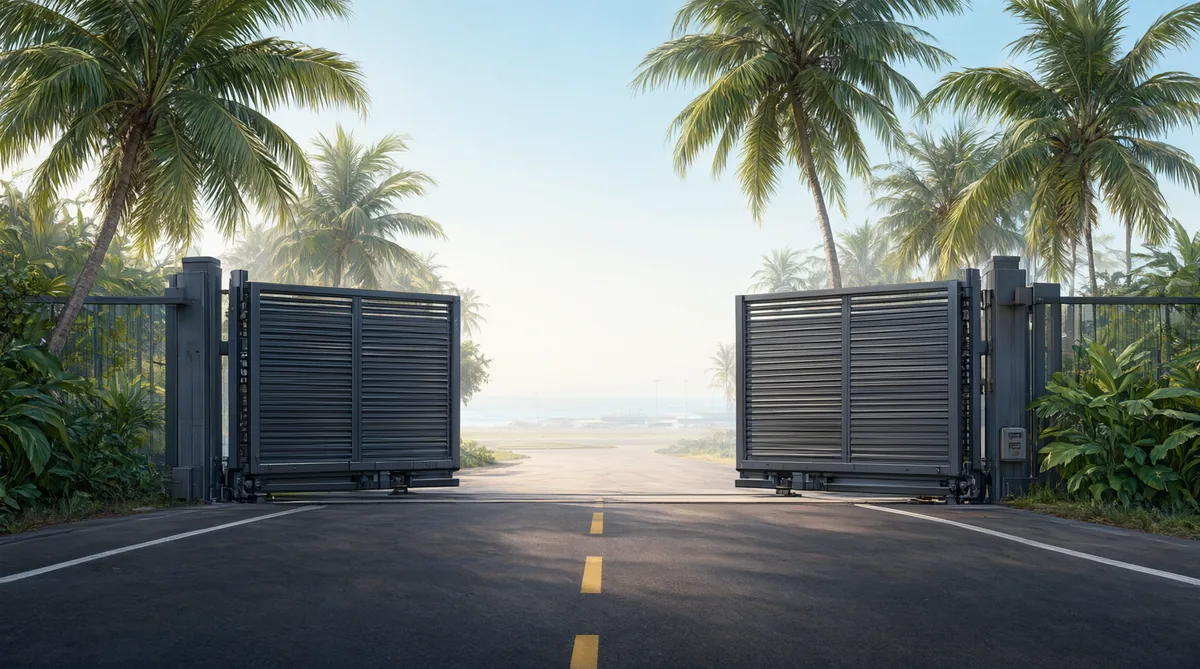
Our best example is an international airport perimeter in the Maldives. We don't name the airport, but the full story is on our Maldives airport perimeter project page.
They needed a 22 m (72 ft) clear opening. The climate is tropical and marine, with salty, humid air all year. One leaf that long would have been too slow at peak times. It was also beyond the 18 m single-leaf span to begin with.
So we supplied a bi-parting system: two leaves, each with 11 m of clear opening and 16.5 m overall (the 1.5 ratio again). The frames are 6005-T6 aluminum finished in AkzoNobel industrial anti-corrosion powder coating, double cured. A 7.0 mm thick bottom beam and precision balancing hold the leading edges level, with zero sagging at the tips. Millisecond-level synchronized control runs both leaves, and an infrared safety array watches the gap.
The result was simple. Opening time dropped by half compared with a single leaf.
Planning a bi-parting site, step by step
- Measure the opening and both side runs. Look for posts, drains, curbs and slopes in each storage zone. A single car parked in the wrong spot will block a leaf.
- Pour two foundations. Each side needs a foundation pit of 800 x 800 x 800 mm in C20 concrete or better. Our manual has you set the rear hanger wheel about 1.5 cm lower than the front cabinet support wheel. For the full pour, see our cantilever gate foundation guide.
- Run power to both sides. Every drive gets its own switch, a 6 A breaker and a reliable earth. Use 60 mm PVC conduit, and leave about 1.5 m of cable above grade at each cabinet.
- Don't forget wind. With reinforced embedded parts, the standard beams handle roughly Beaufort force 8 to 12. On a coastal or typhoon site, ask for custom reinforcement: a bigger bottom beam, extra embeds, diagonal tie rods on both sides and a larger motor. Tall leaves (we go up to 4.0 m) catch more of it.
- Cover the whole width with safety devices. A single infrared beam pair reaches up to 20 m. At 36 m you'll need more than one. Fit pressure safety edges to both leading edges too. For US sites, DoorKing's summary of ASTM F2200 makes a handy checklist: guard the weight-bearing rollers and keep gaps to fixed objects at 2.25 in or less.
- Plan the traffic pattern. At a busy entrance, the wide gate often stays open through peak hours while license plate recognition and a high-speed barrier handle throughput. At night it closes, with infrared anti-climb on watch.
The recommended CAIMEN combination
Most wide openings get the pairing below. You'll find the full numbers on the cantilever gate specifications page.
- Two cantilever leaves made from our four 6005-T6 beam profiles. Expect a 302 x 213 mm bottom beam with walls up to 7.0 mm, a 12-wheel carriage, a stainless steel pull-rod bracket and cast steel pull rods. Because the design bolts together, there's less welding on site. Carriage details are on the cantilever gate hardware page.
- Two 500 W VFD drives with soft start and soft stop, running 18 to 22 m/min on 110 or 220 V AC at 50/60 Hz. They're rated for -35 to +70 C, depending on motor and configuration.
- Coating: AkzoNobel Interpon D1000 is standard, and the powder meets AAMA 2603. For salt air, go with Interpon D2000, which meets AAMA 2604. Bear in mind those results describe the powder coating, not the complete gate.
- Safety pack: infrared beams, safety edges, mechanical anti-pinch, an overhead sensor with warning light, a 10-second anti-climb alarm, emergency stop and manual release.
- Access control (optional): LPR, RFID, keypad, remote or app, all through a standard dry contact interface. See the options on our safety and access control page.
What to send for a quote
Skip the long call. A short email covering these points gets you drawings sooner:
- Clear opening width and the free run on each side
- Gate height and infill style, plus a RAL color
- Double or opposite opening (or ask us to recommend)
- Ground condition and any slope across the opening
- Distance to the coast and local wind exposure
- Supply voltage and the access control you plan to use
- A few site photos from both sides
First you get CAD drawings and renderings back from us. Nothing goes into production until you approve them, and production typically takes 15 to 20 days after drawing approval. Email the details to [email protected], or use the contact page.
Sources
- Chain Link Cantilever Gate Installation Manual - Hoover Fence
- Gate Safety (ASTM F2200 slide gate criteria) - DoorKing
CAIMEN product figures come from our installation manuals and engineering documentation.