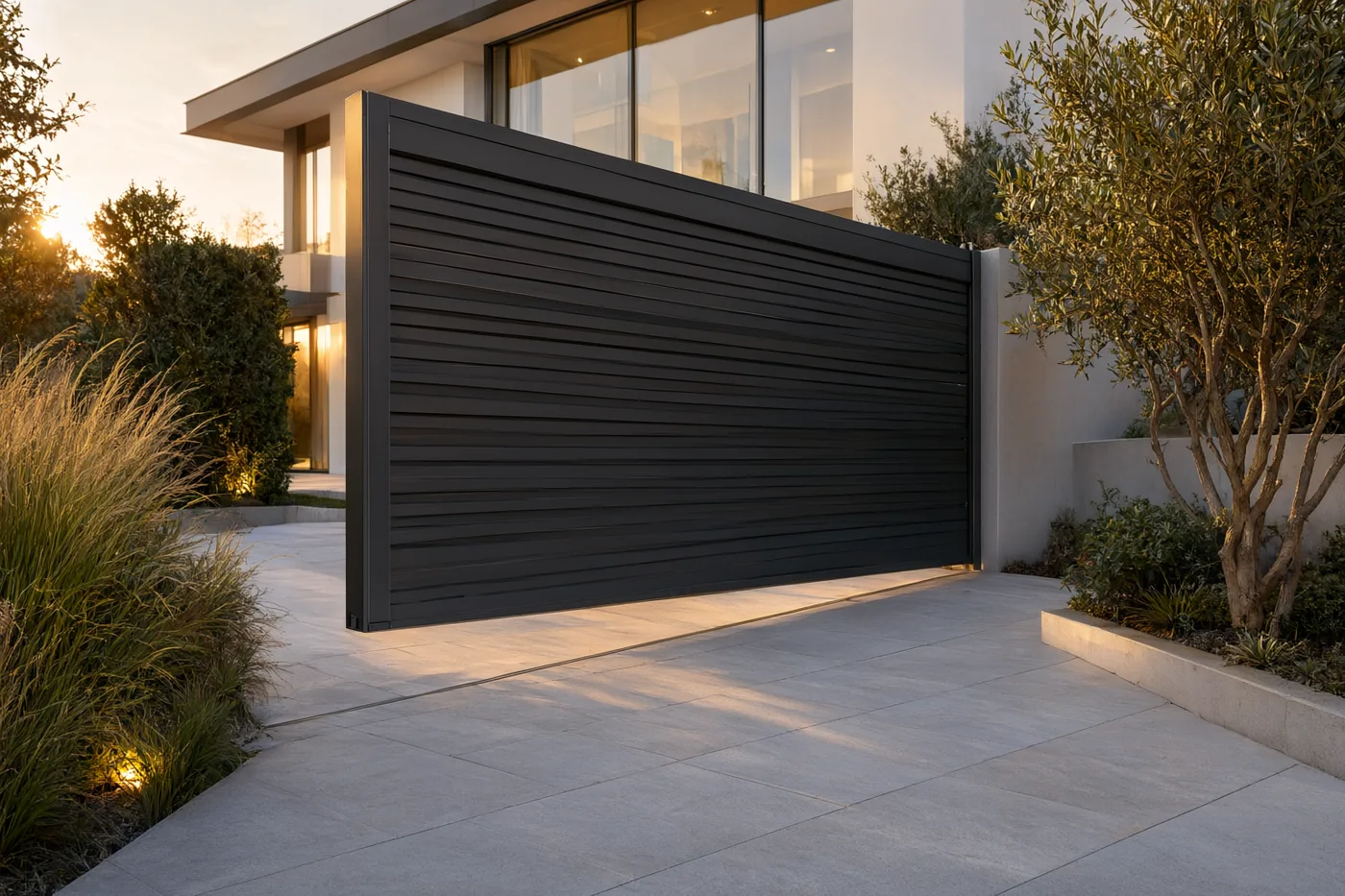
You've just laid a new stone drive. The last thing you want is a steel track cut across it, and that's why so many people end up reading about cantilever gates for driveways. This kind of gate hangs off a carriage at the side of the opening. It rolls across on its own wheels up there, never on the ground. So there's no rail, no groove, and nowhere for leaves to pile up.
Sounds easy. Mostly it is, until you start planning. Four things decide whether it'll work at your house: how the drive slopes and what it's paved with, how tall the leaf is next to the motor cabinet, what goes in the infill, and how the gate behaves when kids, pets or a courier are around.
The driveway problem a cantilever gate solves
Track gates run on a rail set into the ground across the whole opening. Fine on a farm lane. On porcelain pavers or natural stone you'd be cutting the surface, bedding a rail in concrete, then putting up with a metal strip that gathers grit and ice and, now and then, a pebble that jams a wheel.
Swing gates skip the rail. They want a clear arc inside, though, and two cars parked near the entrance will kill it.
Our trackless design takes the ground rail out of the drive completely. Uneven terrain, heavy snow and sand build-up are all named in our product documentation as sites it suits. At a house, you get a clean threshold and a gate that still opens the morning after a snowfall. Still deciding? Read our comparison of cantilever and track sliding gates.
There's a catch, and it's side space. Because the leaf is longer than the opening, it has to park somewhere when it's open.
Sizing the leaf for a typical driveway
Every opening in our installation manual comes with a total gate length. The rule never changes: total length is 1.5 times the clearance. That extra half is the counterbalance tail riding on the carriage. Below is the residential end of the table, in millimeters.
| Clearance (opening) | Total gate length | Passage width |
|---|---|---|
| 3000 | 4500 | 2564 |
| 3500 | 5250 | 3064 |
| 4000 | 6000 | 3564 |
| 5000 | 7500 | 4564 |
| 6000 | 9000 | 5564 |
Check the passage width column first. A 4,000 mm clearance leaves about 3,564 mm of usable drive. One car with its mirrors out? Comfortable. A delivery van swinging in at an angle is another story. Say you've got a 3.5 m gap between two brick piers and you drive a pickup. Go up a size. It beats scraping a mirror every month.
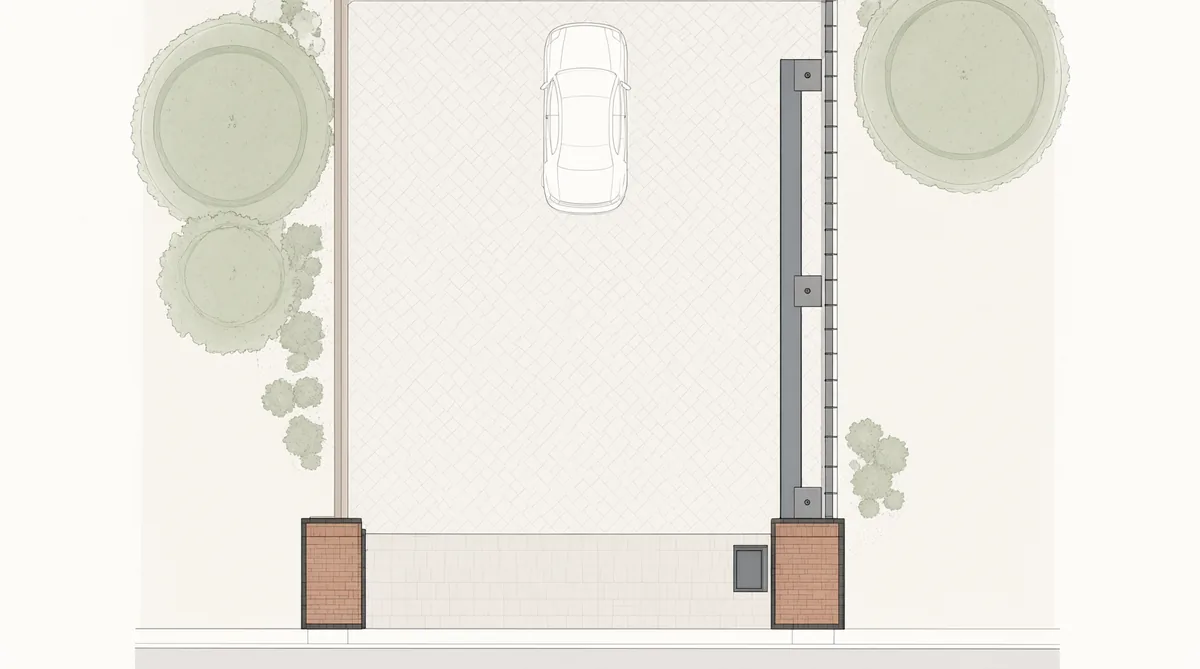
Next, walk the fence line. Alongside the opening you'll need a straight, level run about as long as the whole gate, with no trees, meter boxes or neighbor's hedge in the way. Short on run? Our article on cantilever gate side space covers what you can do, and a wide drive can be split into a bi-parting pair.
Sloped and tiled drives
Let's be blunt. This gate moves in a straight, level line, and it won't follow a drive that climbs toward the house.
Our installation manual wants the cabinet, gate frame and hanger wheels on one horizontal plane, within plus or minus 10 mm. The rear hanger wheel goes about 1.5 cm lower than the front cabinet support wheel, using the lever principle. So even if your drive isn't level, the foundations have to be.
On a slope, watch the gap under the leaf. Ground clearance is 110 mm to 133 mm, depending on model. If the drive rises across the opening by more than that, the bottom beam will hit the paving somewhere in its travel. Measure from the lowest point of the opening up to the highest point the leaf crosses, in the opening and along the parking run too. Then send us the figures and we'll check them against the model.
Steep drive? These fixes usually work:
- Put the gate line on the flattest stretch, often right at the property boundary before the climb begins.
- Build a short level apron in the same tile, so the change in grade happens behind the gate.
- If the side ground drops away, carry the parking run on a raised plinth or garden wall.
Tiled drives add a timing issue. Each foundation pit in our manual is 800 x 800 x 800 mm, poured in concrete no weaker than C20, and the cable goes through a 60 mm PVC conduit. Get all of that in before the tiler shows up. Digging a pit through finished porcelain is the expensive route, so read our foundation article before you sign the paving contract.
Leaf height vs cabinet height
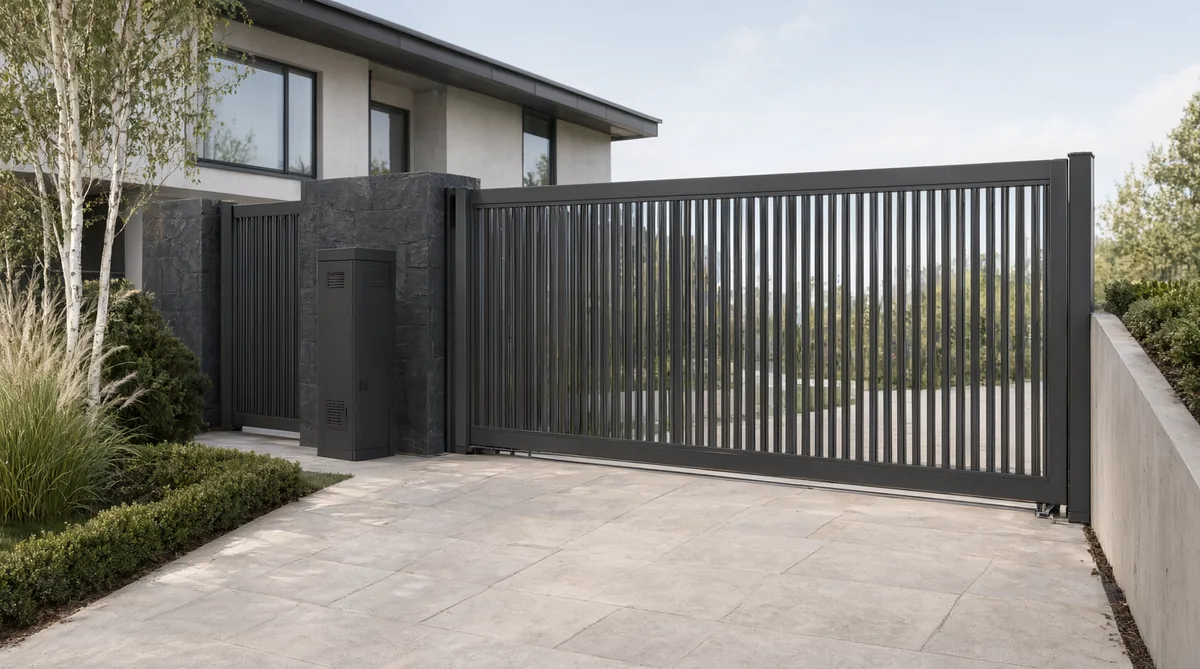
The motor cabinet is taller than the gate. Most people don't see that coming, and it changes how the front of your house looks.
In our installation manual the cabinet steps up by a fixed amount:
- 1600 mm leaf, 1853 mm cabinet
- 1800 mm leaf, 2053 mm cabinet
- 2000 mm leaf, 2253 mm cabinet
- 2200 mm leaf, 2453 mm cabinet
Call it 25 cm of cabinet above the top beam, whatever height you pick. Next to a low front wall, a 1.6 m gate leaves the cabinet standing out like its own post. With a 2.0 m gate between tall piers, you'll barely notice it. Want it hidden? Plan the pier or a planted screen around it now, and leave room to get in for service.
Privacy wants a taller leaf. Street appeal often doesn't. Check your local height limit for front boundary walls before you choose.
Design choices that suit a house
The frame's aluminum: a 6005-T6 bottom beam with walls up to 7.0 mm, a 6005-T6 top beam, and 6063-T5 vertical bars at 47 x 37 mm. Aluminum won't rust through at the welds. Near the coast, or on a street that gets salted every winter, that counts for a lot. Our aluminum cantilever gate page goes through the profiles in detail.
Standard finish is AkzoNobel Interpon D1000 powder coating, which meets AAMA 2603 and Qualicoat Class 1. For an upgrade there's Interpon D2000 (AAMA 2604, Qualicoat Class 2). Keep in mind those ratings describe the coating, not the whole gate. Custom RAL colors are on offer, so matching your window frames or garage door isn't hard.
Infill is where one house really differs from the next. Vertical bars look classic and let the breeze through. Whatever style you want, it's chosen per project, the profiles are picked to suit it, and you'll see it on a CAD drawing and rendering first. Nothing gets made until you approve. Production typically takes 15 to 20 days after drawing approval.
Safety for families, kids and pets
Where do kids ride their bikes? Often on the driveway, right where a heavy gate moves. Give it the respect it deserves.
You can fit our cantilever gate with an infrared beam that stops and reverses the leaf, a pressure-sensitive safety edge on the leading edge, mechanical anti-pinch protection, an overhead sensor with a warning light, an emergency stop and a manual release. In a power cut, the manual release lets you disengage the motor and move the leaf by hand. The clutch itself takes no more than 200 N to operate. Once stopped, it holds with a self-locking force of at least 300 N. The full list is on safety and access control.
Hardware gets you halfway. Layout and habits do the rest, and the Door and Access Systems Manufacturers Association (DASMA) sets this out in its gate system safety guidance:
- Add a separate pedestrian gate. DASMA states automated gates are for vehicles only.
- Mount keypads and push buttons at least 6 feet (1.8 m) from any moving part, so nobody reaches through the bars.
- Keep remotes out of kids' hands, and don't let them play on or near the gate.
- Guard rollers and pinch points less than 8 feet (2.5 m) above grade, and screen openings so a 2.25-inch sphere can't pass.
That last point shapes the design. With a toddler or a small dog at home, tighter infill or mesh on the lower section isn't just a style call.
In the US, gate operators come under UL 325, which DASMA notes sets entrapment protection criteria by operator class. Ask your installer how they'll set up sensors for your site. We don't claim UL 325 or ASTM F2200 listing for the gate.
What to send for a quote
Good numbers make a good quote. Send these through our contact page or to [email protected]:
- Clear opening width between your posts or piers.
- Length and condition of the side run where the gate will park.
- The height you'd like, plus any local limit on front boundary height.
- Driveway slope across the opening and along the parking run, and the surface type.
- Opening direction: left, right, or a bi-parting pair.
- Power supply (110 V or 220 V), and how you'll open it: remote, keypad, intercom or app.
- A photo or two and a color reference.
As for the drive unit, a 500 W variable-frequency motor moves the leaf at 18 to 22 m/min with soft start and stop. It runs from -35 to +70 °C. Everything else is on our specifications page. Rough measurements are fine. Send what you've got, and we'll come back with a drawing.
Sources
CAIMEN product figures come from our installation manuals and engineering documentation.