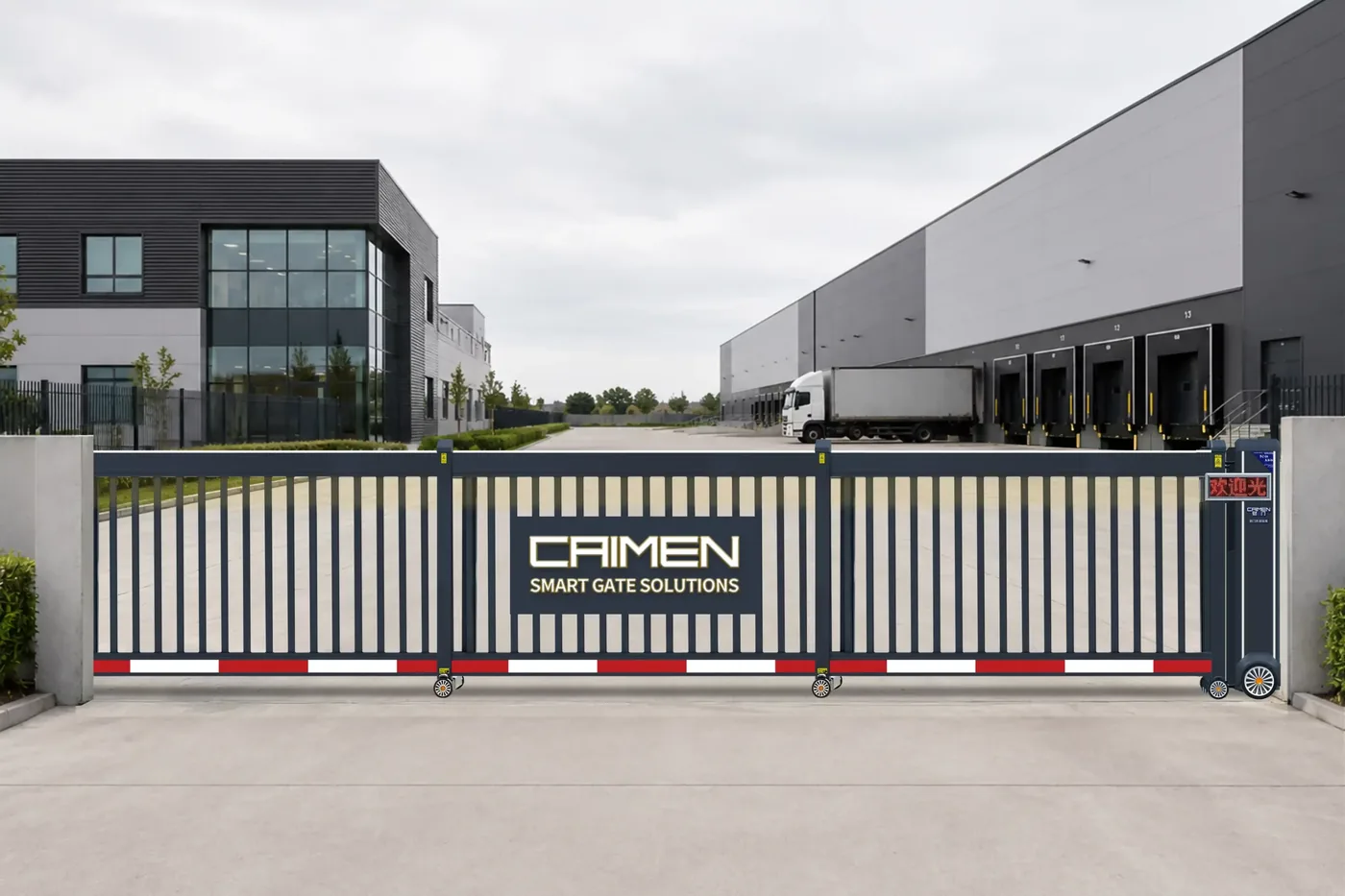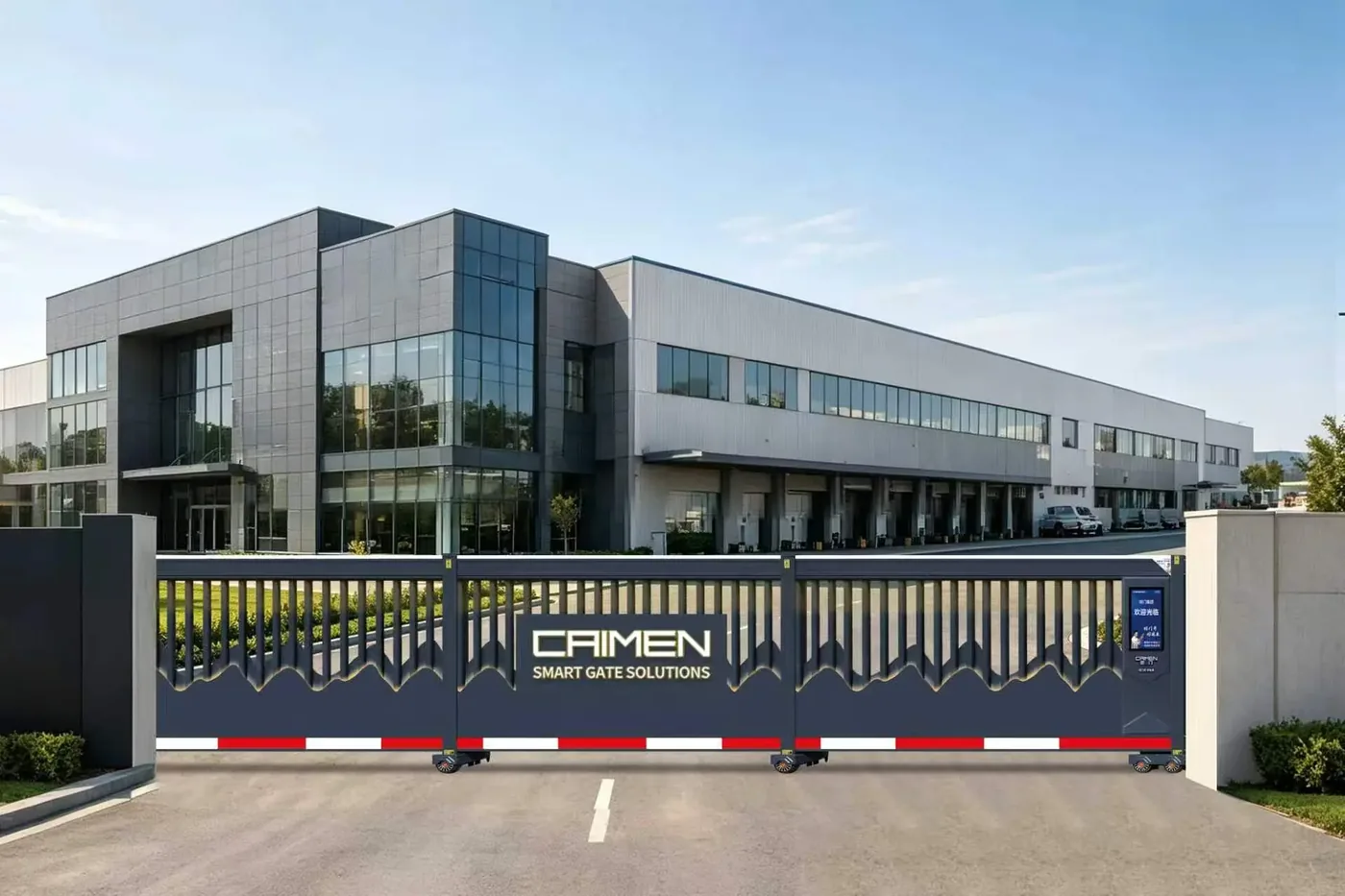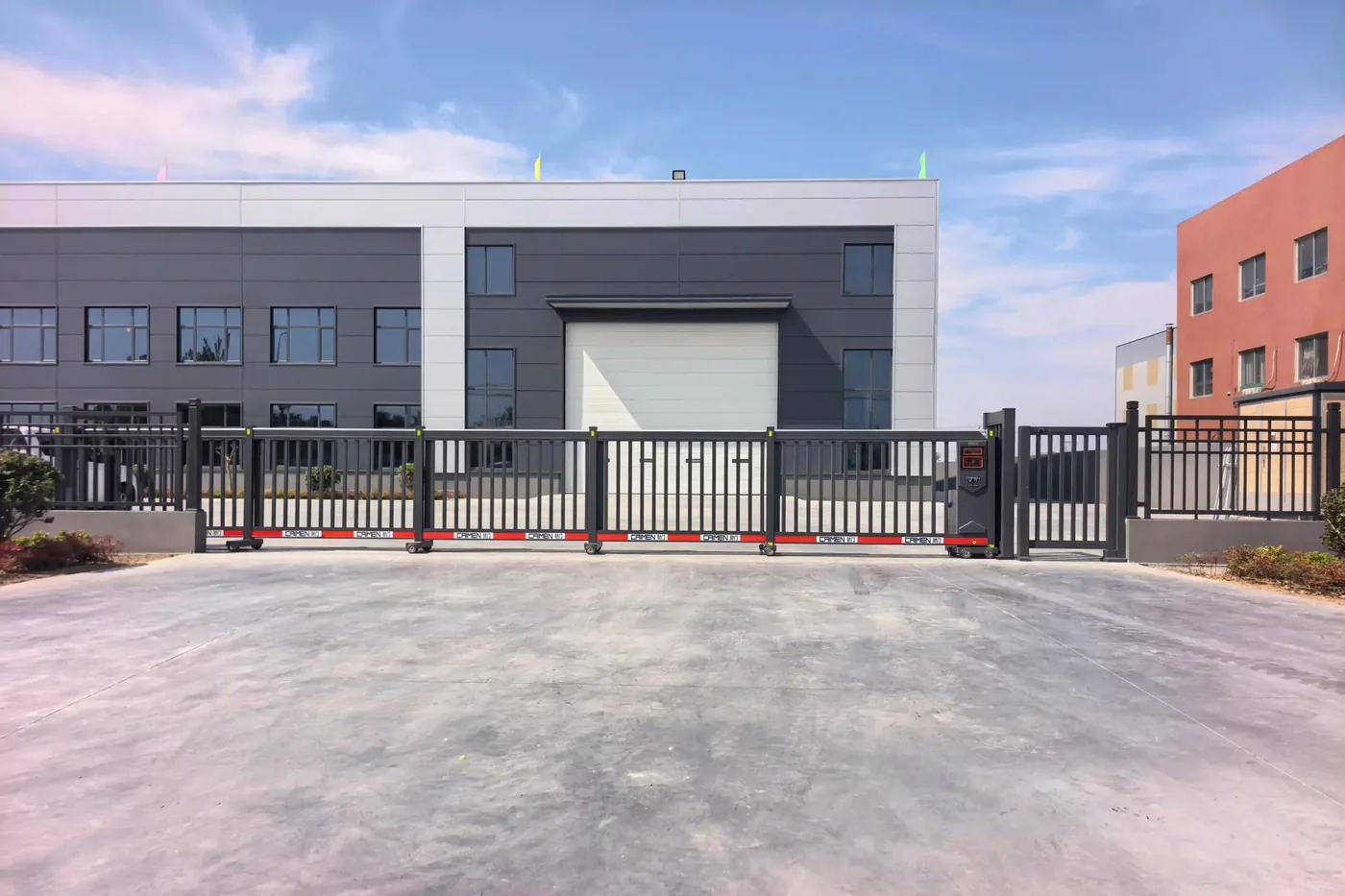
Both gates slide sideways, and that's about all they share. A cantilever gate hangs off rollers beside the opening. It never touches the driveway. A conventional sliding gate is different: it rolls on a V-track that's set into the ground across the whole entrance. So if you're stuck on cantilever vs sliding gate for a plant, a depot or a campus, you're really answering four questions. What crosses your driveway? How much fence line sits beside it? What's the ground like? And how much digging can you live with?
We'll take them in order. There's a side-by-side table near the end, plus a short list of sites where we'd honestly pick the track gate.
How each gate carries its weight
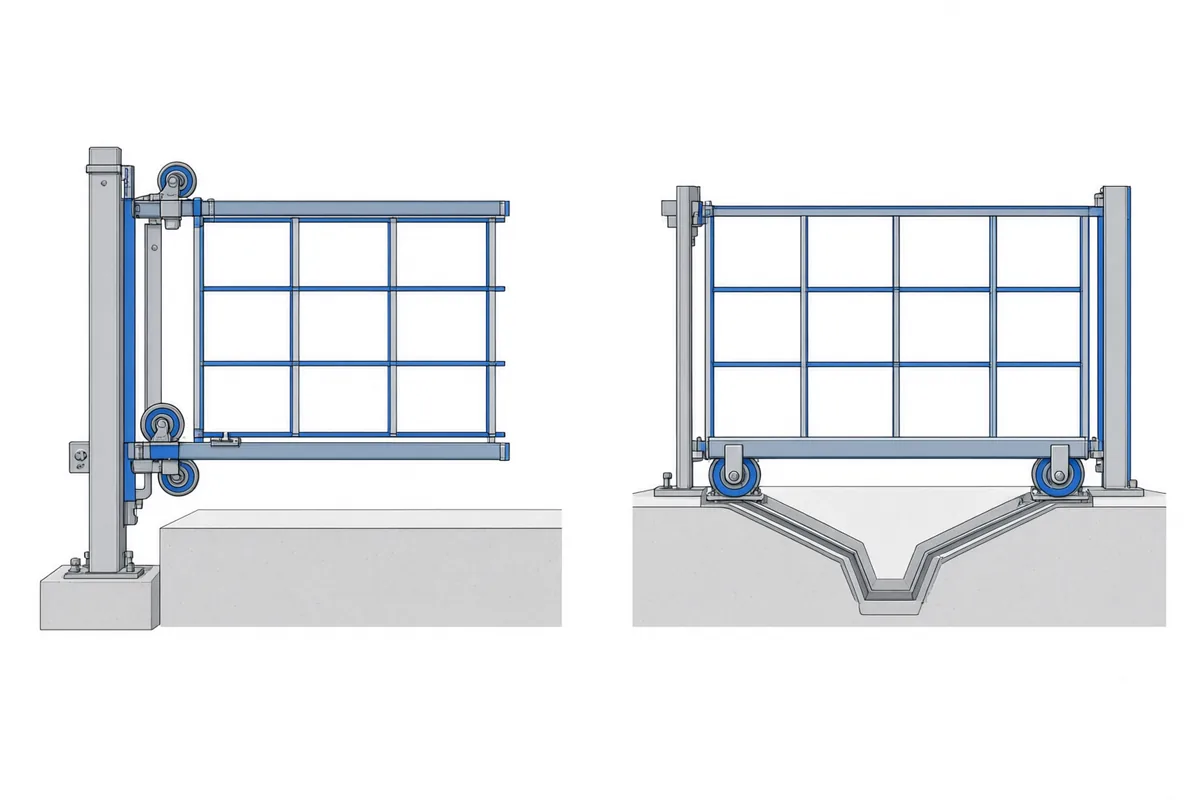
Start with the track gate, because there isn't much to it. Grooved wheels ride an inverted-angle rail anchored in concrete, and that rail runs the full width of the opening plus the parking area. The ground holds the gate up at every point of its travel. Keep the rail straight, level and clean and you'll get years out of it.
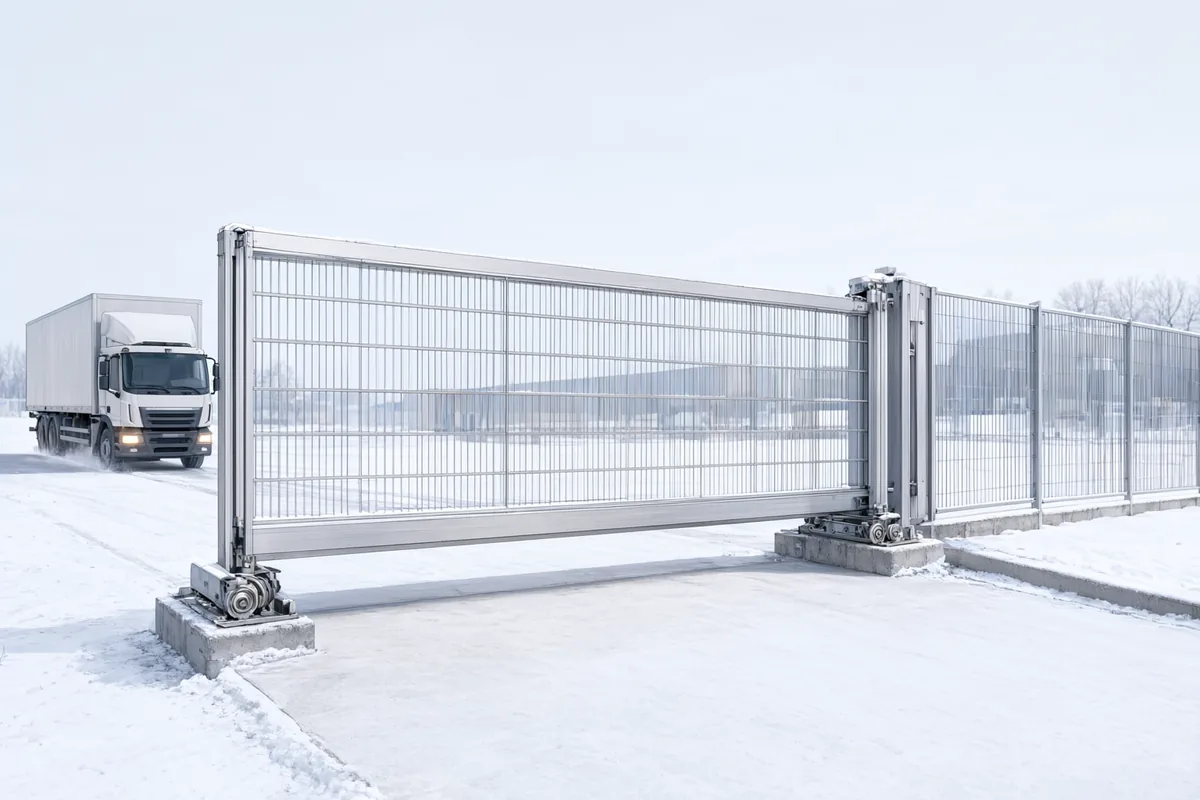
The cantilever is closer to a seesaw. Its leaf is built longer than the opening, and the extra length (the counterbalance tail) stays behind the roller carriages when the gate's closed. That tail's weight offsets the part reaching across the gap. The leading edge floats. Inside the opening, nothing touches the ground.
You'll find the same split in the industry standard for horizontal slide gates. ASTM F1184 treats cantilever slide gates (Type II) as gates with no top or bottom support within the opening. Rolling gates that need on-grade support get a separate type, and Class 1 there covers gates on a full on-grade track. Same family. Different physics.
On CAIMEN's cantilever sliding gate, the load goes through a 12-wheel carriage with top, bottom and side rollers, a stainless steel pull-rod bracket and cast steel pull rods. Then there's the bottom beam: 6005-T6 aluminum, 302 x 213 mm, with walls up to 7.0 mm. Think of it as the spine. It's holding the leaf out like a diving board, so it had better be stiff.
Ground clearance: the part buyers underestimate
This is where a floating gate earns its keep. Depending on the model, our installation manual lists ground clearance between 110 mm and 133 mm, roughly 4.3 to 5.2 inches. Under the bottom beam there's just air.
Picture your own apron in a bad week. Trucks fling gravel around. October brings leaves, and sand drifts in off the yard. Then a fresh 3 inches of snow lands overnight. A V-track gate has to roll over every bit of that, and one stone under a wheel can lift it off the rail or stall the operator. The cantilever leaf? It goes right over the top.
For northern sites, snow is the big one. You'll have to shovel or heat a track before it runs reliably, and ice packed in the groove can stop the gate dead. Your plow driver won't face that with a cantilever, because there's nothing embedded in the pavement to catch a blade.
Slopes are the other headache. Tracks must be laid level, so a driveway falling toward the street gets regraded or fitted with a stepped rail. A cantilever is far less fussy. Only its own carriages and post need to share one level plane, and our manual allows plus or minus 10 mm for the cabinet, frame and hanger wheels. Whatever the driveway does underneath is its own business.
Side space: where cantilever gates ask for more
That tail costs you something. Since the leaf is longer than the opening it closes, the whole length needs somewhere to park when the gate's open.
CAIMEN's installation manual ties gate length to the clear opening with a fixed ratio. Check any row below and you'll see total length is 1.5 times the clearance.
| Clear opening (mm) | Total gate length (mm) | Passage width (mm) |
|---|---|---|
| 3,000 | 4,500 | 2,564 |
| 4,000 | 6,000 | 3,564 |
| 5,000 | 7,500 | 4,564 |
| 6,000 | 9,000 | 5,564 |
| 7,500 | 11,250 | 7,064 |
Take a 6 m opening. You'll need room for a 9 m leaf to slide back along the fence line, clear of buildings, trees, transformers and parked cars. Over the same opening, a V-track gate is typically only a little longer than the gap, since it has no tail to store.
Tight fence line? Look at a bi-parting layout. Two leaves, each with its own tail, split the run-back between both sides. A single CAIMEN cantilever leaf reaches clear spans up to 18 m, and bi-parting takes that to 36 m. You'll find full dimensions and profiles on our specifications page.
Foundations and installation
Both gates need concrete. Where it goes is what separates them.
With a track gate, you're pouring a continuous footing, or at least a well-compacted paved strip, under the rail across the full opening and the parking zone. That cuts straight across your driveway. The entrance stays shut while the pour cures, and if the ground settles later, you'll see it as a dip in the rail.
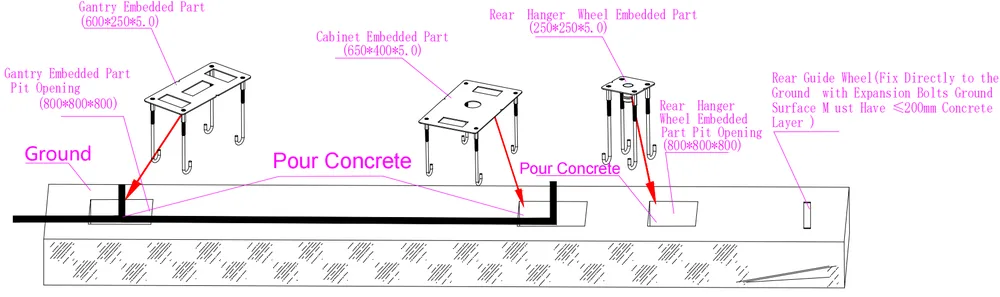
A cantilever puts its load into the carriage posts beside the opening instead. Our installation manual calls for an 800 x 800 x 800 mm pit with concrete no weaker than C20, and the embedded plate centered 40 cm from the reference line. It also sets the rear hanger wheel about 1.5 cm lower than the front support wheel at the cabinet. Why bother? That small drop pre-loads the leaf so the tip doesn't sag. And because the work happens off to the side, your driveway stays open while the footings cure.
One warning, though. Don't skimp on that footing. A cantilever post fights a lever arm, not just dead weight, and an undersized pad is a frequent cause of tip droop. Build it to the manual's 800 mm cube of C20 and you've ruled that out. Our installation page covers the full sequence.
Cantilever vs sliding gate: side-by-side comparison
| Factor | Cantilever gate | V-track sliding gate |
|---|---|---|
| Contact with driveway | None inside the opening | Rolls on rail across full opening |
| Snow, ice, gravel, sand | Passes over (110 to 133 mm clearance on CAIMEN models) | Track must be kept clear or the gate stalls |
| Sloped or uneven driveway | Workable, carriages set level | Track must be level or regraded |
| Side space when open | About 1.5 times the opening | Slightly more than the opening |
| Foundation | Concentrated footings beside the opening | Continuous base for the rail |
| Wear parts | Enclosed rollers and carriages | Track wheels and the rail itself |
| Vehicle crossing | Flat, nothing embedded | Rail in pavement under every wheel |
Safety: same rules, different pinch points
Every automated slide gate has spots that can catch a hand or a foot. They just sit in different places. On a track gate, the wheels and rail are at ground level, right where people walk. A cantilever moves the exposure up to the carriages and the gap at the support posts.
Whichever you pick, DASMA's installer's guide to ASTM F2200 is worth a read. Weight-bearing exposed rollers under 8 feet above grade must be guarded or covered, it says, and gaps between the gate panel and a support structure can't exceed 2.25 inches. Ask your supplier how their design handles both.
On CAIMEN's cantilever system, an infrared beam (covering up to 20 m) and a pressure-sensitive safety edge work alongside mechanical anti-pinch protection. You also get an overhead sensor with warning light, an emergency stop and a manual release. Stopped, the gate holds at least 300 N of self-locking force, yet the manual clutch opens with no more than 200 N. For how those tie into LPR and RFID, see safety and access control.
When a V-track sliding gate is still fine
We build cantilever gates. Even so, a track gate is sometimes the better call:
- Short openings with little side room. Say you've got a 4 m opening and just 5 m of fence before a building. A cantilever wants 6 m of run-back. It won't fit, and a track gate will.
- Paved, flat, sheltered sites. Picture a courtyard entrance under a canopy, swept daily, in a mild climate. Debris won't put up much of a fight.
- Very heavy infill on a short span. With ground support everywhere, you lean less on the beam and footing.
- Low cycle counts. A back gate opened twice a week won't repay a contact-free run.
Now flip the list. Wide openings, trucks crossing all day, freeze-thaw winters, sand or gravel yards, sloped approaches, an entrance you can't close for a week while someone trenches in a rail: that's cantilever territory. Imagine a logistics hub where tractor-trailers cross the apron dozens of times a shift. A rail in that pavement gets hammered. A floating leaf never sees the abuse.
For wide perimeter openings, the conversation usually lands on a trackless sliding gate. CAIMEN drives it with a 500 W variable-frequency motor at 18 to 22 m/min, rated for -35 to +70 °C depending on motor and configuration.
Next step
Grab a tape measure. First the clear opening, then the straight, unobstructed fence line on the side where the gate will park. Got 1.5 times the opening? A cantilever gate is on the table. If you don't, price a bi-parting layout or a track gate. Send both numbers and a few photos to [email protected] or through our contact page, and we'll return CAD drawings before anything goes into production. Production typically runs 15 to 20 days after drawing approval.
Sources
- ASTM F1184 Standard Specification for Industrial and Commercial Horizontal Slide Gates
- DASMA: An Installer's Guide to ASTM F2200
CAIMEN product figures come from our installation manuals and engineering documentation.