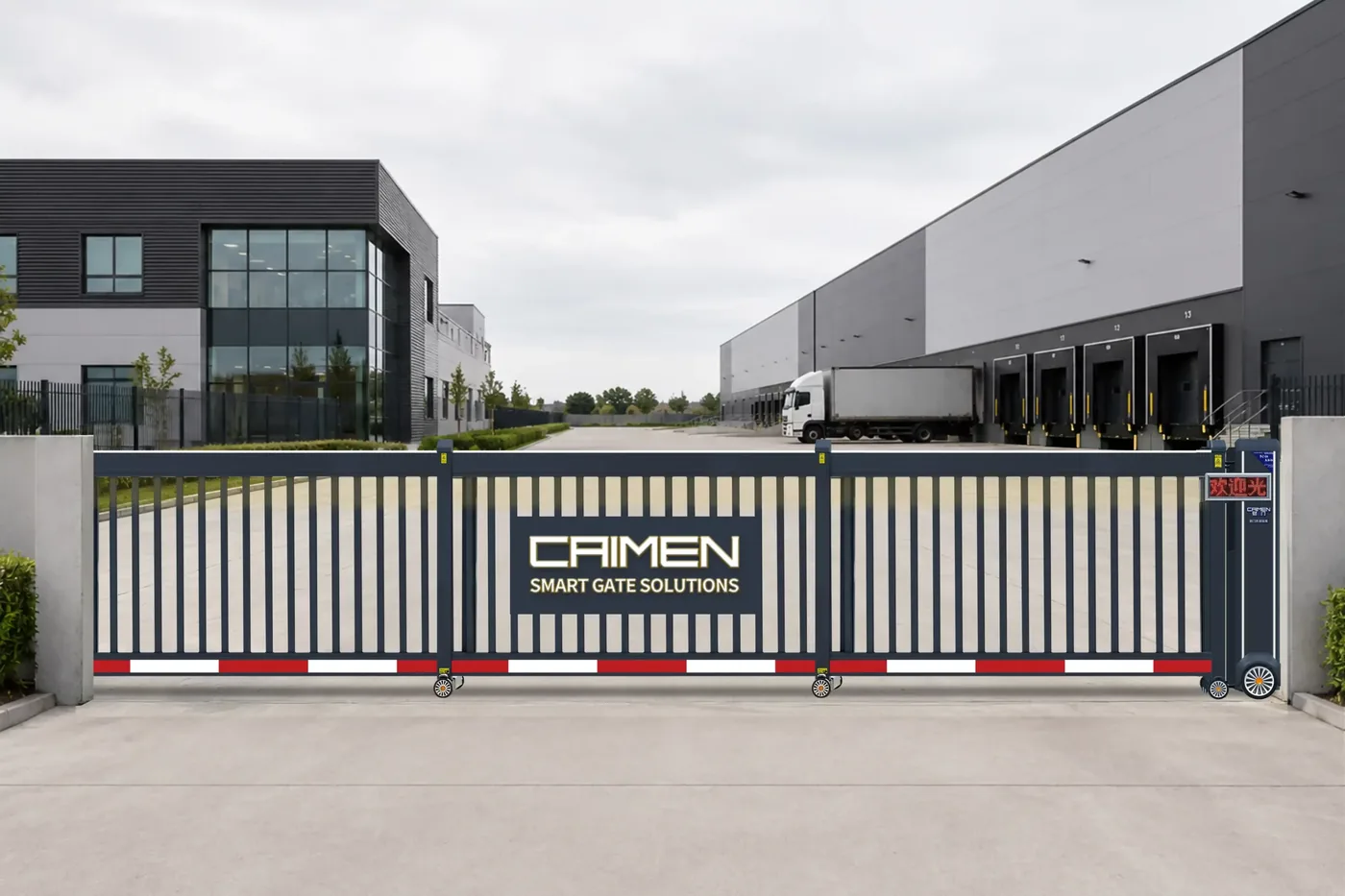
A home driveway gate opens maybe ten times a day. Industrial sliding gates? They get hammered. Think of a distribution center at 6 a.m.: loaded trucks every few minutes, a forklift crossing the apron forty times a shift, and a night crew that still wants the perimeter locked tight at 2 a.m. Here's how we'd plan that entrance with a CAIMEN cantilever gate, from why trackless matters to which beam and drive we'd pick, plus the trick of pairing the gate with license plate recognition so it never turns into your bottleneck.
The problem with busy industrial entrances
Most site managers start with the gate. That's backwards. Start with the traffic.
Factory main gates, logistics yards and port terminals tend to fight the same three battles. The openings run wide, usually wider than a standard swing or track gate handles comfortably. Vehicles don't trickle in; they arrive in waves, because shift changes and dispatch windows pile everyone up at the same hour. Then there's the ground itself, which gets tire scrub, dropped pallets, sand, snow and standing water.
Put a ground track across that driveway and you've found where the trouble starts. Debris packs into the rail. Wheels jump. Every axle that rolls over it chews off a little more, and once the rail is damaged the whole gate is down, along with your inbound flow.
So what does the brief look like? Span a wide opening, keep the driveway clear, run all day without anyone babysitting it, and lock up hard after hours.
Why a trackless cantilever gate fits
A cantilever gate hangs from a carriage system on one side of the opening. It rolls across without ever touching the driveway. No rail for trucks to pound, nothing for gravel or ice to jam. Our product documentation lists it for exactly these sites: wide openings, high-traffic entrances, and ground where a track is hard to install or keep working, such as uneven terrain or places with heavy snow and sand buildup.
You do pay for it in side space. Because the leaf needs a counterbalance tail, it's longer than the opening. Run the numbers across our installation manual's sizing table and total gate length comes out at 1.5 times the clearance, so a 7,500 mm clearance means an 11,250 mm gate. Walk your fence line first. Our guide to cantilever gate side space covers that measurement in detail.
Where it typically goes, according to our engineering documentation:
- Factory main gates and industrial park security gates
- Trackless gates for logistics hubs
- Heavy duty sliding gates for manufacturing plants
- Airports and hangars, government offices and police compounds
Choosing the beam: span, height and infill
Everything rides on the beam. Choose well and the leading edge stays level for years. Undersize it, though, and you'll watch the nose droop.
We work with four 6005-T6 aluminum cantilever beam profiles, each with its own section size and wall thickness. Which one you get depends on gate length, gate height, infill style and load. At the heavy end, the bottom beam measures 302 x 213 mm with a wall up to 7.0 mm; the top beam is 113 x 93 mm with a 2 to 6 mm wall.
| Site need | CAIMEN option | Planning note |
|---|---|---|
| Opening up to 18 m | Single-leaf cantilever | Max single-leaf total length 28 m as delivered |
| Opening up to 36 m | Bi-parting cantilever | Two leaves meet in the middle, shorter travel each |
| Tall perimeter fence | Custom height | Up to 4.0 m |
| Coastal or chemical air | Interpon D2000 coating upgrade | Standard is Interpon D1000 |
| Heavy leaf, frequent use | 12-wheel carriage, cast steel pull rods | Bolt-together modules, less site welding |
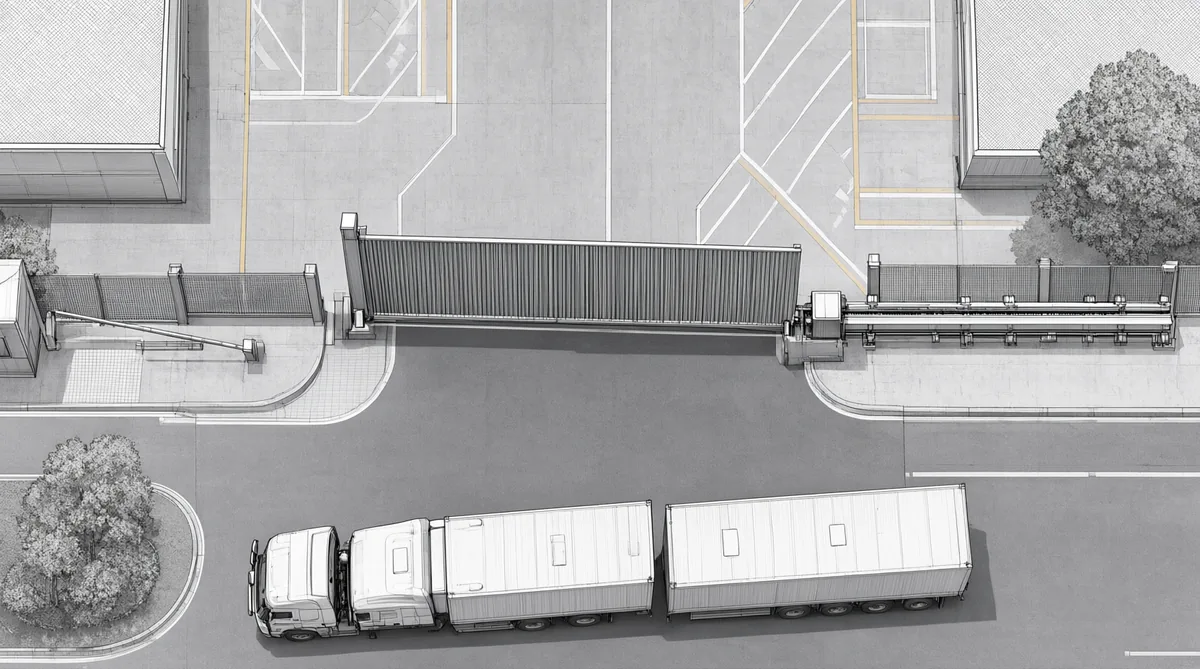
One call we make a lot: on a very wide opening where trucks queue at peak, consider bi-parting, even when a single leaf could technically span it. Each leaf only travels half the distance, so the lane clears sooner. That's exactly what drove the one cantilever case in our records. An international airport perimeter in the Maldives needed a 22 m clear opening in salty, humid air, and a single leaf would have been too slow. We built two 11 m clear-opening leaves (16.5 m each overall) on 6005-T6 aluminum with a 7.0 mm bottom beam and AkzoNobel coating. Bi-parting cut the required opening time in half. The full story is on the Maldives airport perimeter project page.
About the finish. Standard AkzoNobel Interpon D1000 powder meets AAMA 2603 and Qualicoat Class 1, while the optional D2000 meets AAMA 2604 and Qualicoat Class 2. Keep in mind those ratings describe the powder coating, not the complete gate. Sitting next to a port or a fertilizer plant? Ask about the upgrade.
Choosing the drive and safety package
Out of the box you get a 500 W variable frequency motor. You can set speed anywhere from 18 to 22 m/min, and soft start and soft stop keep a long aluminum leaf from slamming into its end stops. It runs on 110 V or 220 V AC at 50/60 Hz. The rated operating range is -35 °C to +70 °C, depending on motor and configuration, which covers most hot ports and cold northern warehouses; just confirm the motor configuration for your climate.
Don't cut corners on safety. A gate this size moves serious mass, and people walk right past it. Here's what the package includes:
- Infrared beam obstacle detection (stop and reverse), covering up to 20 m width
- Pressure-sensitive safety edge on the leading edge
- Mechanical anti-pinch protection, plus an overhead sensor and warning light
- Emergency stop and manual release (manual clutch force 200 N or less)
- Infrared anti-climb alarm that sounds for 10 seconds on intrusion
- Self-locking force of at least 300 N when stopped
On US projects, expect your installer to bring up ASTM F2200. That's the ASTM International specification for automated vehicular gate construction, and it sets requirements for how gates like these are built and guarded. Talk it through with your local installer and inspector. Our safety and access control page covers each safety device in more detail.
The hybrid: cantilever gate plus LPR and barrier
Most buyers miss this part.
Even a fast cantilever gate needs time to cross a wide opening. Cycling it for every single vehicle at 7 a.m.? Slow, and hard on the drive for no real gain. We'd rather split the job in two.
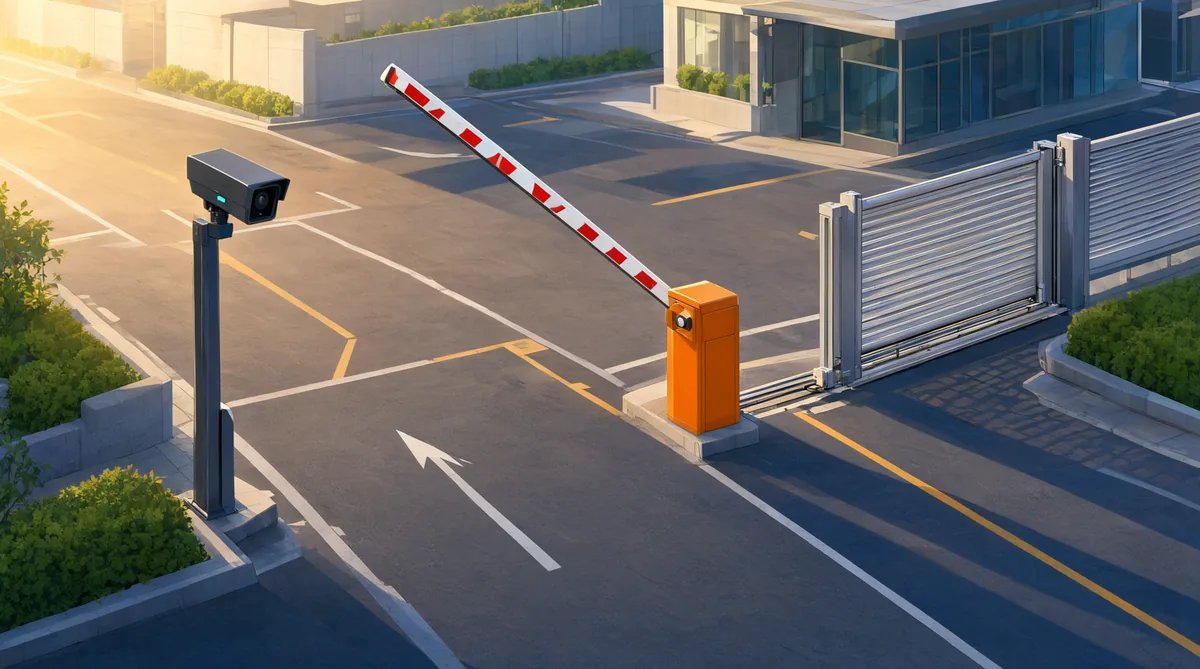
- Peak hours: leave the cantilever gate open. License plate recognition cameras and a high-speed barrier handle each vehicle. CAIMEN's KS01/KS02 high-speed barriers open or close in 1.2 to 2.5 seconds depending on arm length.
- Off-peak and night: the cantilever gate closes, and the infrared anti-climb alarm guards the line.
Genetec's ALPR access control documentation lays out the basic flow. A camera reads the plate, the system checks it against a hotlist of authorized plates, and a match can trigger an action such as raising the gate or barrier. Drivers don't have to stop and badge in. As for the gate, it takes LPR, face or fingerprint readers, keypads, visual intercom, RFID, remote, mobile app and Bluetooth through a standard dry contact relay, so the access system you already own can usually drive it.
Say you run a cross-dock that sees 60 trucks between 6 and 8 a.m. The barrier does the repetitive work. Your gate does what it's good at, which is standing there as a solid, locked wall after dark.
How to plan the installation
Installation day goes smoothly or it doesn't. A handful of site facts decide which.
- Foundation: our installation manual calls for an 800 x 800 x 800 mm pit with concrete of at least C20. See our cantilever gate foundation guide for more.
- Level: cabinet, gate frame and hanger wheels must sit on one plane within plus or minus 10 mm.
- Power: an independent switch with a 6 A breaker and reliable grounding.
- Wind: on coastal or typhoon sites, ask for reinforcement such as a larger bottom beam, extra embedded parts or diagonal tie rods.
Think about opening modes as well. A bi-parting gate can run as double opening, with both centers on one line, or as opposite opening, where the two leaves sit about 40 cm apart so they can't collide.
What to send us for a quote
We draw before we build. You'll see CAD drawings and renderings first, and production only starts once you approve them; it typically takes 15 to 20 days after drawing approval. Want to move fast? Send us:
- Clear opening width and the side space available for the tail
- Gate height and preferred infill style
- Site photos, ground condition and climate (coastal, desert, snow)
- Power supply voltage and frequency
- Peak vehicle counts and whether you want the LPR and barrier hybrid
- Access methods your site already uses
Full beam and drive data live on our specifications page. Email [email protected] or use the contact page. You'll get a drawing back, not a brochure.
Sources
- ASTM F2200 Standard Specification for Automated Vehicular Gate Construction
- Genetec Security Center Administrator Guide: ALPR access control
CAIMEN product figures come from our installation manuals and engineering documentation.