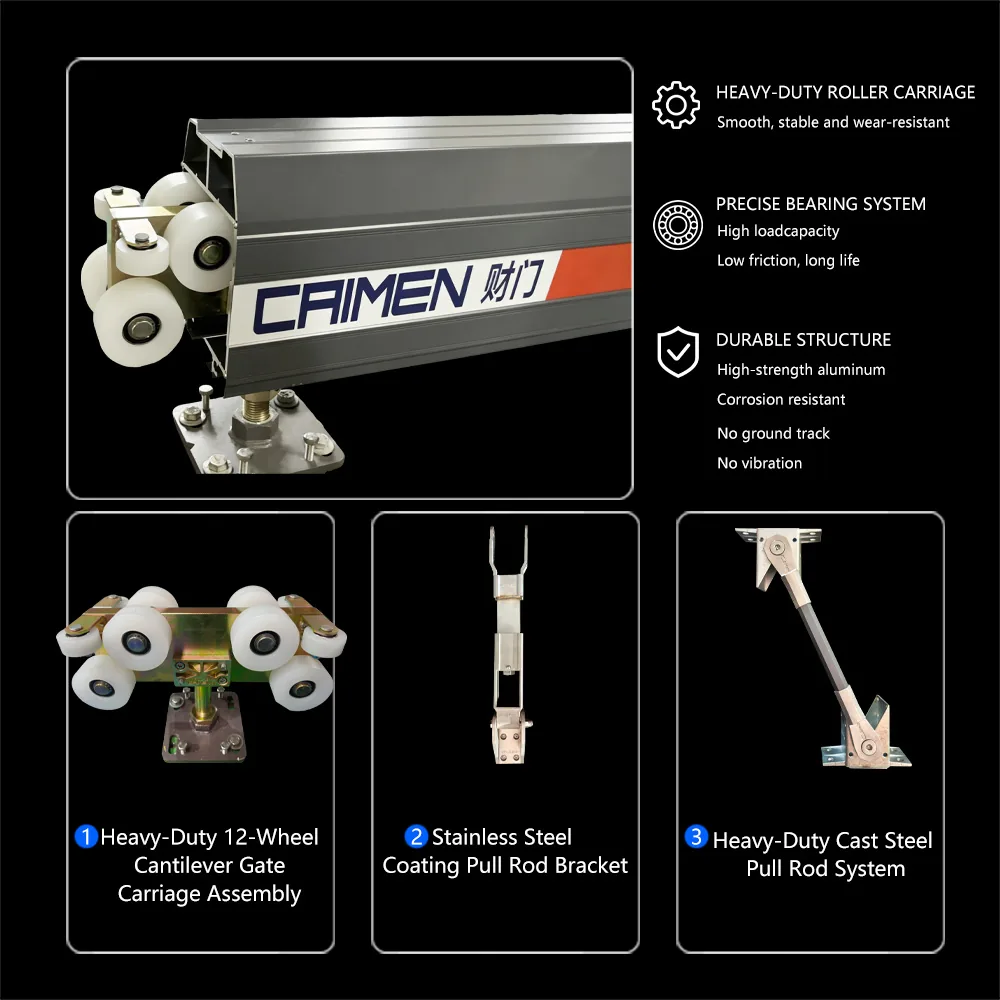
12-wheel multi-directional carriage
Top, bottom and side rollers support the beam vertically and laterally, so the leaf does not twist or rock.
Roller carriages, pull-rod systems and guides specified for 20 m+ aluminum leaves.
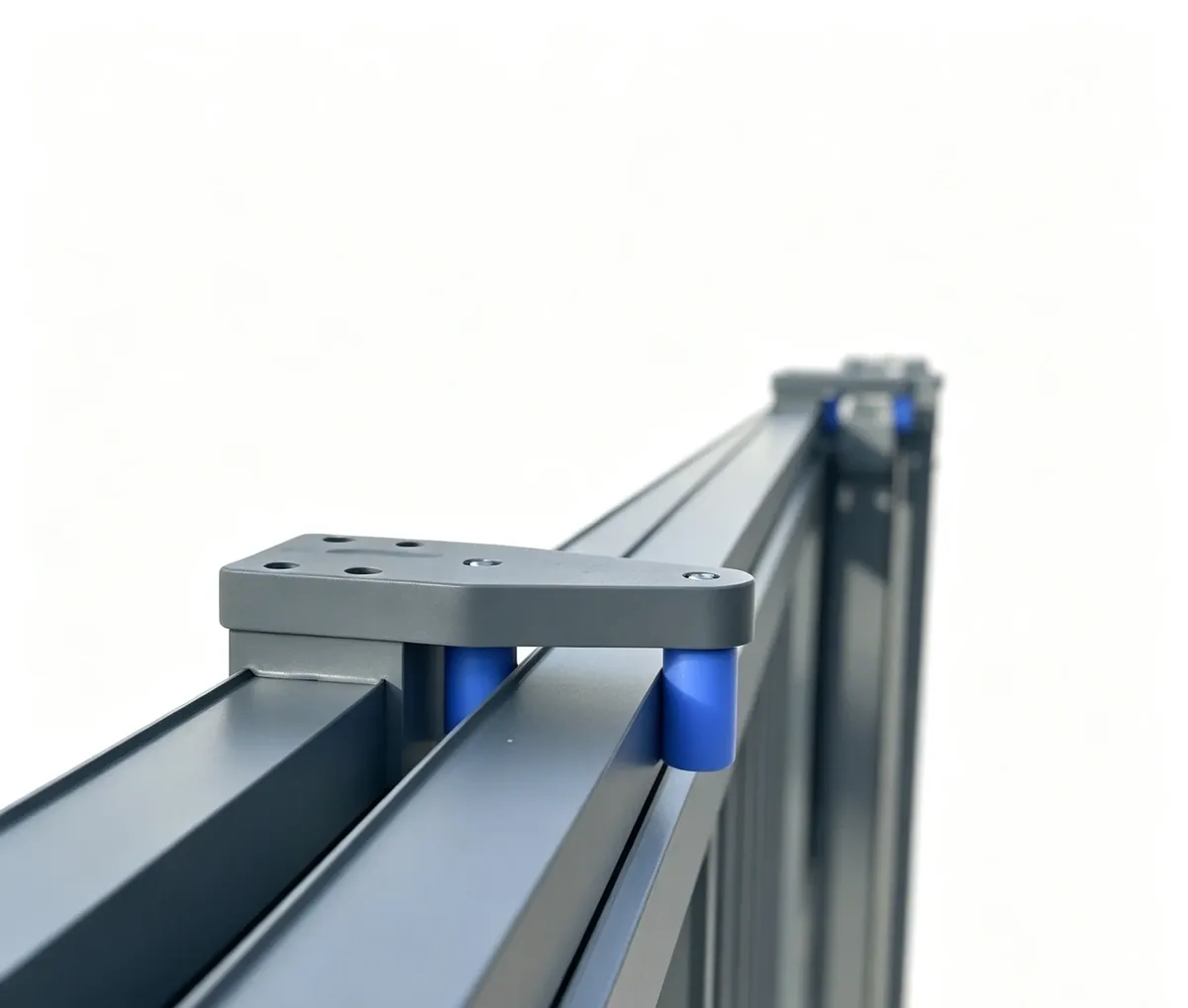
Top, bottom and side rollers support the beam vertically and laterally, so the leaf does not twist or rock.
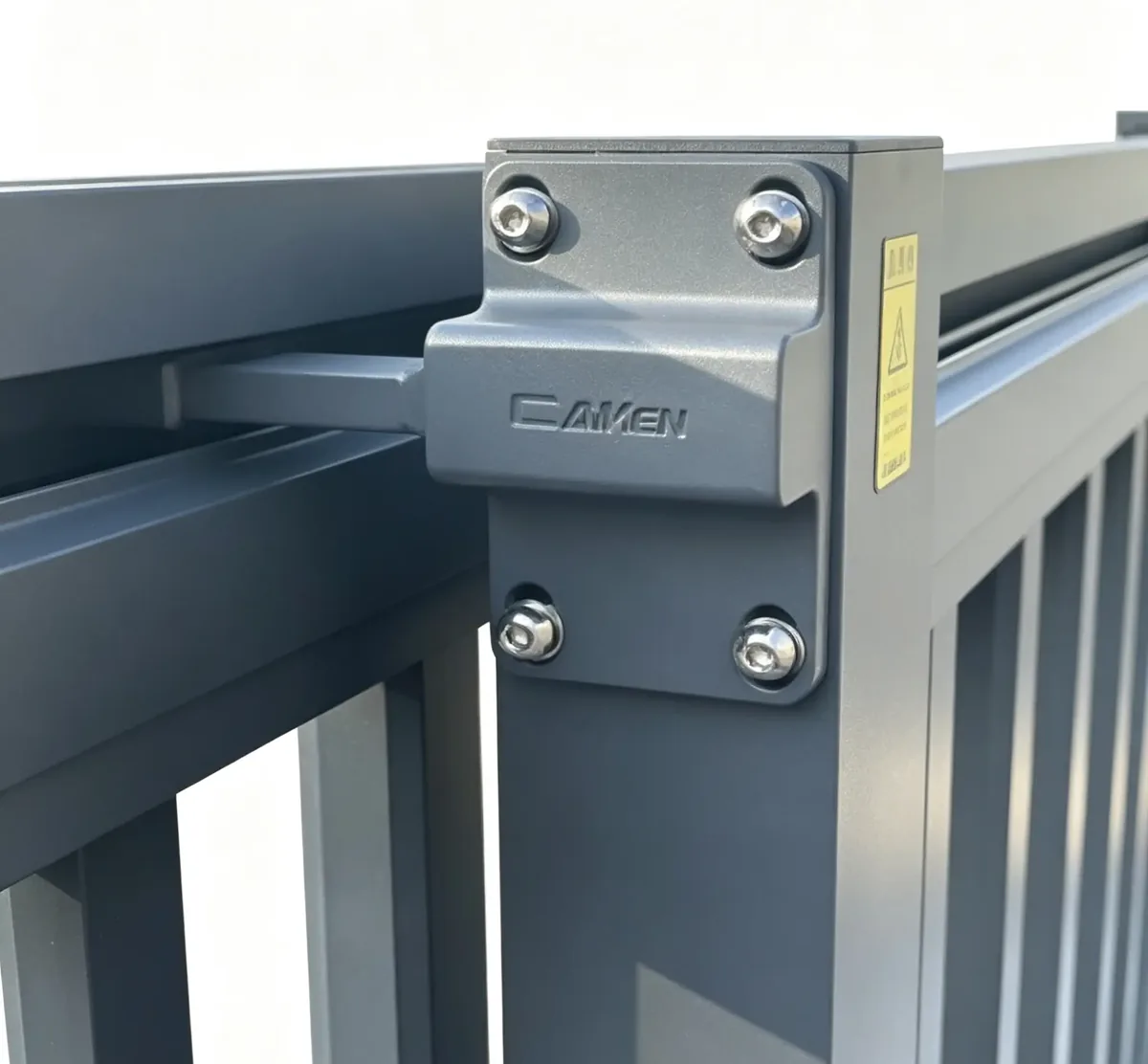
Heavy-duty rollers and bearings keep rolling resistance low over repeated cycles.
Diagonal pull rods with cast steel heads control deformation on large gates.
Keeps alignment across longer spans and resists corrosion.
Carriages, rollers and reinforcements can be adjusted or replaced one by one.
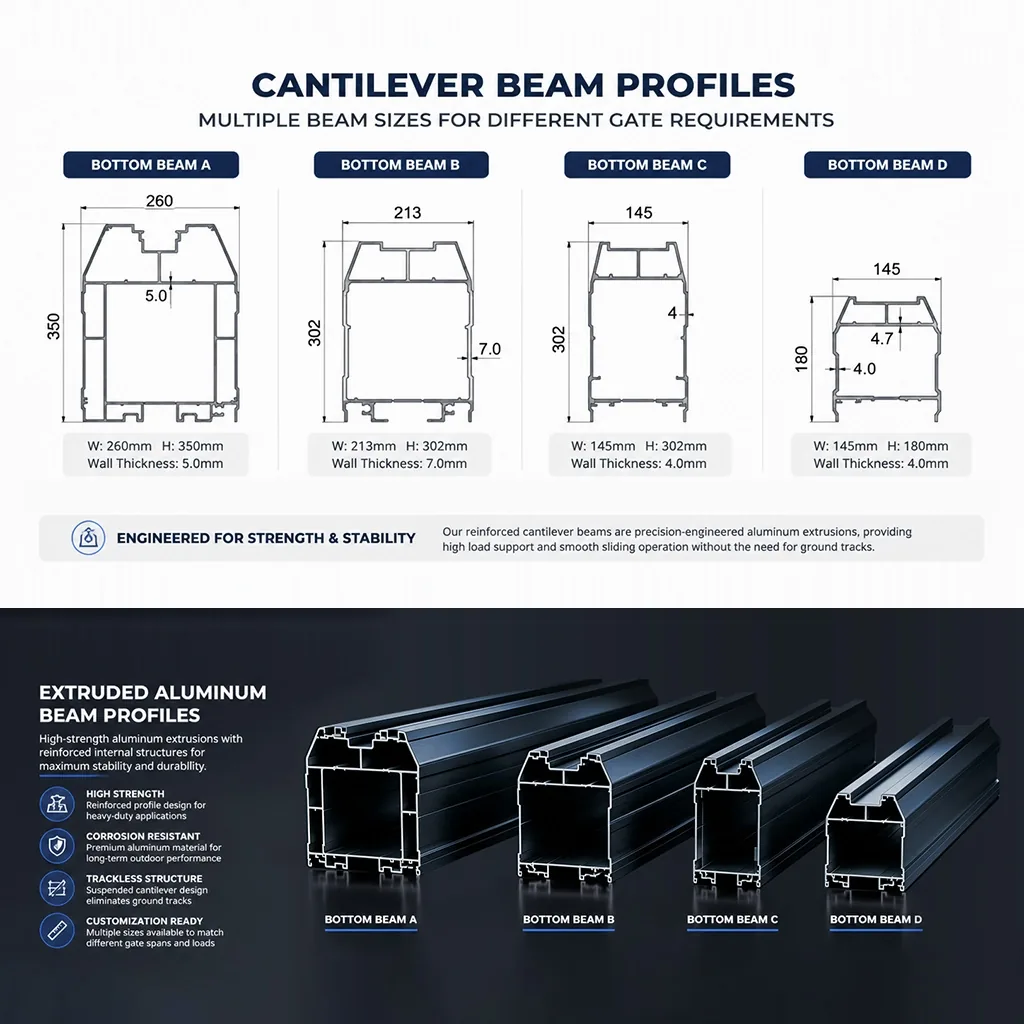
Carriage size follows the beam. We match carriage, roller set and pull-rod layout to the 6005-T6 profile chosen for your gate length and height.
During installation the rear hanger wheel is set about 1.5 cm lower than the front cabinet support wheel, using the lever principle, so the leading edge does not drop.
Cantilever Gate Hardware is what holds a CAIMEN leaf in the air. Carriages, rollers, pull rods, brackets: the beam rides on all of them, and if they're wrong, even a good beam will sag, rub or wander off line. When they're right, the leaf rolls smoothly and stays aligned over repeated cycles.
You won't find us selling these parts as loose catalog items picked by guesswork. They ship as part of a complete aluminum cantilever gate, built around one of our four 6005-T6 aluminum beam profiles. Which profile? That depends on gate length, height, infill design and structural load.
Every carriage grips the beam from three directions, with top, bottom and side rollers. Why bother? Three forces act on a hanging leaf. The bottom wheels take its weight. Up top, a second set keeps the tail from lifting, while the side rollers stop a crosswind from pushing the leaf off line.
Precision bearings in heavy-duty rollers cut rolling resistance. Less drag means less work for the drive on each cycle, and you'd feel that most on a long leaf opening dozens of times a shift. It also eases the load on the 500 W drive, while the VFD handles soft start and stop.
Long spans like to droop at the nose. To fight that, a stainless steel pull-rod bracket ties into the frame and a heavy-duty cast steel pull-rod system adds tension, resisting deformation under load and keeping the leaf aligned across the span. At the receiving end, our engineering documentation also lists a cast steel joint base, a stainless steel door guide and a heavy-duty guide wheel.
Nothing here needs heavy site welding. The structure uses modular bolt-together connections, so if one roller wears, your crew swaps that roller and moves on. Carriage, roller and reinforcement parts can each be adjusted or replaced on their own.
Use it wherever a trackless leaf has to stay true across a wide opening. Typical spots:
Say your 6 m clear opening sits right next to a parking lane. That job won't look like a 4 m residential drive, and it shouldn't be specified like one.
Start with the beam, not the wheels. We choose from four 6005-T6 profiles based on gate length, height, infill design and structural load. The biggest bottom beam measures 302 x 213 mm with walls up to 7.0 mm, and the top beam is 113 x 93 mm with 2 to 6 mm walls.
People underrate wheel heights. Don't. Our installation manual wants the motor cabinet, gate frame and hanger wheels on the same plane within plus or minus 10 mm, with the rear hanger wheel about 1.5 cm lower than the front cabinet support wheel so the lever action keeps the nose up. Ground clearance runs 110 to 133 mm, depending on the model. The installation manual specifies an 800 x 800 x 800 mm foundation pit in concrete no lower than C20; you'll find the full sequence in our installation guide.
| Clear opening (mm) | Total gate length (mm) | Hanger wheel distance (mm) | Guide wheel distance (mm) |
|---|---|---|---|
| 4000 | 6000 | 1500 | 2500 |
| 6000 | 9000 | 2500 | 3500 |
| 7500 | 11250 | 3250 | 4250 |
See the pattern? Total length is 1.5 times the opening, and that extra half gives the counterbalance tail its room. Writing a spec around ASTM F1184? It's the industry standard describing horizontal slide gates, cantilever type included, so it makes a good checklist of what to ask. It isn't a certification we claim.
For a quote, send us:
Email [email protected] or use the contact page. Production typically takes 15 to 20 days after drawing approval.
Sources
Product figures come from CAIMEN product documentation.
It's supplied as part of the complete CAIMEN gate system. The carriage, roller and reinforcement parts are serviceable, though, and each can be replaced on its own. Hoping to use parts on a different gate? Send us the beam section, a few photos and the opening size, and we'll give you a straight answer.
A cantilever leaf behaves like a lever over its supports. Our installation manual sets the rear hanger wheel about 1.5 cm lower than the front cabinet support wheel, so the nose stays level once the leaf runs out over the opening. Skip that step and it tends to dip toward the receiver post.
Twelve, arranged as top, bottom and side rollers on every CAIMEN carriage. Bottom rollers carry the vertical load. The top set stops the tail from lifting, while the side rollers limit sideways movement, so travel stays smooth and stable over repeated cycles.
Pull rods give extra structural support on large gates and help control deformation. That's why longer, taller leaves get the most from them: they're the ones likely to sag at the nose. Building on the coast or in a typhoon zone? Our installation manual lists double-side diagonal pull rods as one reinforcement option there.
Send photos of your beam profile and carriage. We will tell you whether our parts fit.
Or email [email protected]